I currently live just over one hundred miles from where I grew up.
When I drive from south of Seattle to my hometown of Bellingham, Washington, my favorite part of the scenic drive is the commonly-occurring mountain-level clouds in Skagit and Whatcom Counties.
I recognize now that locals in Whatcom and Skagit counties likely take these clouds for granted. I did while I was growing up.
Now that I live a two hour drive away (when traffic’s not bad!), I live just far enough away to not have these low-lying clouds be a daily (or near-daily) occurrence. Thus, I now notice them as a locally distinct event when I go home. They are visually engaging.
A good writer does the same thing when writing – noticing and/or developing perspective – and then using descriptive narrative – to incorporate that perspective into the written word.
When written text lacks perspective, the reader will notice the text only in observing that what they are reading is not worth reading. They may not know that perspective is what’s missing, but they won’t want to continue reading. It is incumbent upon the writer to identify perspective and incorporate it into the text.
Providing perspective – among a host of skills involved in understanding the world and one’s audience – is necessary for the writer who wants an audience.
In this writer’s blog, I discuss what it means to write. I give examples of what it means to bring the written word to life. Making words meaningful is done in varying ways in different contexts.
Today, I will give the example of bringing words to life in the context of genealogy.
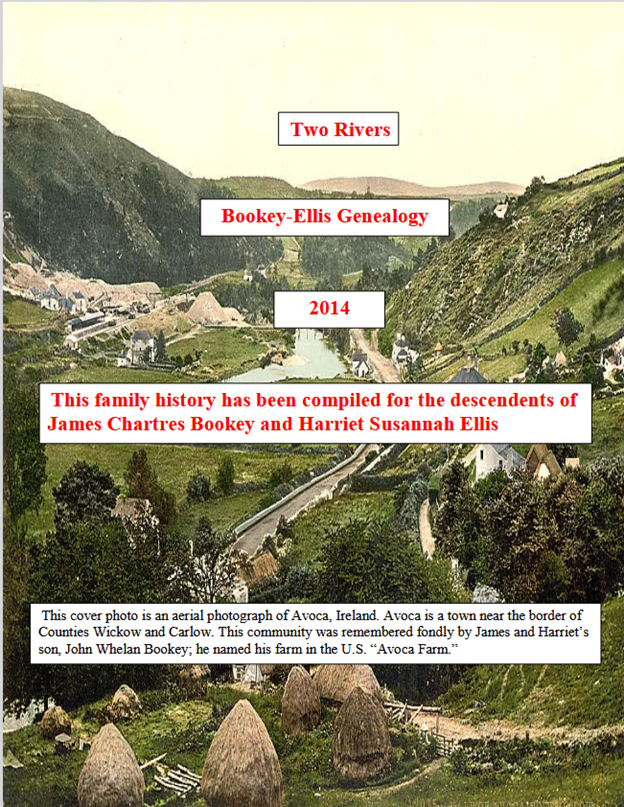
I co-wrote the genealogy book for my Irish-side relatives (2014).
When I say that I co-wrote the book, I mean exactly that. I took the lead on writing the book.
Much of the historical genealogical research was done by a distant cousin in Dun Laoghaire (“Dun Leerie”, a Dublin suburb). He did twenty years of on-the-ground records searching, verifying historically-accurate family data going back to the 1700’s. I followed up with current relatives to collect current family data. I then organized the data chronologically, by relative. There was a tremendous amount of work involved in this research – our family is immensely grateful to my cousin for the years of effort he put into uncovering our family history. This data collection made it possible for us to know who our ancestors were, where they lived, how many kids they had, often finding out what they did for a living.
In this blog, I write about writing. When we published our genealogy book (relatives asked that information in the book about living relatives not be shared publicly for privacy), a friend of the family saw the book on a coffee table and asked for my contact info. When the family friend contacted me, they expressed appreciation for the book because it is different from other genealogy books they had seen. Too often, they observed, genealogy books only – or strictly – list names, dates, dates of birth, locations where people lived and died, and other historical data about relatives. Not so with the genealogy book that I co-wrote. In this genealogy book, I took the lead in including information that brought our ancestor’s lives “to life.” For example, we included:
Old family photographs of previous generations
Old family letters that had been handed down over the generations
Photos of the ships that ancestors rode when they emigrated
Photos of the rural schools attended by our Irish ancestors
A photo of the baptismal font where my great-great grandmother was baptised in the 1860’s
A photo of the door of the hotel where my great-great grandparents stayed when they eloped (the door is still there!)
Family stories that had been handed down. At the turn of the 1900’s, for example, my great-great grandmother discovered that her children were skipping school when the schoolmaster contacted her to ask if she was planning to send her school again; her children said years later that when their mother discovered they were skipping school, “she brought out the switch.” Also, the family home had no plumbing at the turn of the century – the children washed dishes in the stream that ran through the property (I’ve been there and saw the stream. The stream was just a trickle in the summer. Imagine washing dishes in a stream in the winter….). At the same time, a traveling seamstress would come through every six months and stay with the family for a week while she made the family’s clothing…….
Historical explanations such as what it meant for my Irish ancestor’s small rural village to be “a market town” that had market once a week.
Writing, as indicated above, informs the reader of the context surrounding data – bringing the written word to life.
Actually communicating via the written word requires more than factually stating information. I indicated in my previous post, for example, that Robert M. Goldstein’s biographical tale of riding the Trans Siberian Express succeeds at being a laugh-so-hard-you-cry narrative because he did more than state where he travelled and what he did. He was self-transparent, thereby humanizing the story, in describing his mishaps – discovering two days into his trip-of-a-lifetime train ride that he was on the wrong train and telling about his only pair of shoes getting stolen.
At times, the written word does – in fact – call for literal, straightforward facts-and-figures communication. A how-to-assemble document for a piece of furniture or a bicycle requires literal step-by-step instructions. A good communicator, though, recognizes when such step-by-step communication is appropriate – and brings to the communication an understanding of how to be straightforward. “You will need a hammer for this project” demonstrates a writer’s understanding of the human experience involved when crafting the assembly of a useful how-to manual – while also knowing what information not to include (no one cares if your cat sat with you while you crafted the how-to manual). Personal insertions of information might be relevant – on the other hand – when assembling a how-to-ride-the-Trans-Siberian-Express manual (“Here’s a tip I learned on how to avoid getting your only pair of shoes stolen”).
Writing to communicate with an audience isn’t about you. Except when it is about you (an autobiography, for example). Written communication is for the reader. Yet, the reader will be able to see you in the written communication. Does the writer know to tell me to have a screwdriver when assembling a bookshelf? Does the writer know when to insert personal anecdotes to make a story human and therefore compelling? A reader of a professional journal will evaluate the writer of an article – does the writer know industry standards well enough to know the appropriate communication style(s) for that industry and that publication? Does the writer of a novel have enough experience with people to know the communication tools that make a narrative interesting?
I am currently reading a book by an author who narrates U2’s (the Irish rock band) use of visual imagery at their rock concerts. The author observes in the book that when there’s upward/downward tension co-occurring in a song, one band member will walk up stairs while another band member walks down stairs. I had never noticed that in watching U2 concerts. I appreciate author Kevin Ott – and have an increased appreciation for U2 – as a result of Ott’s insightful and descriptive narrative in Ott’s Shadowlands.
Writing – when effective – is clear, descriptive, and informative. When done well, writing also tells us about the writer. Of course, the best writing renders readers so absorbed in content that we don’t notice the medium…..