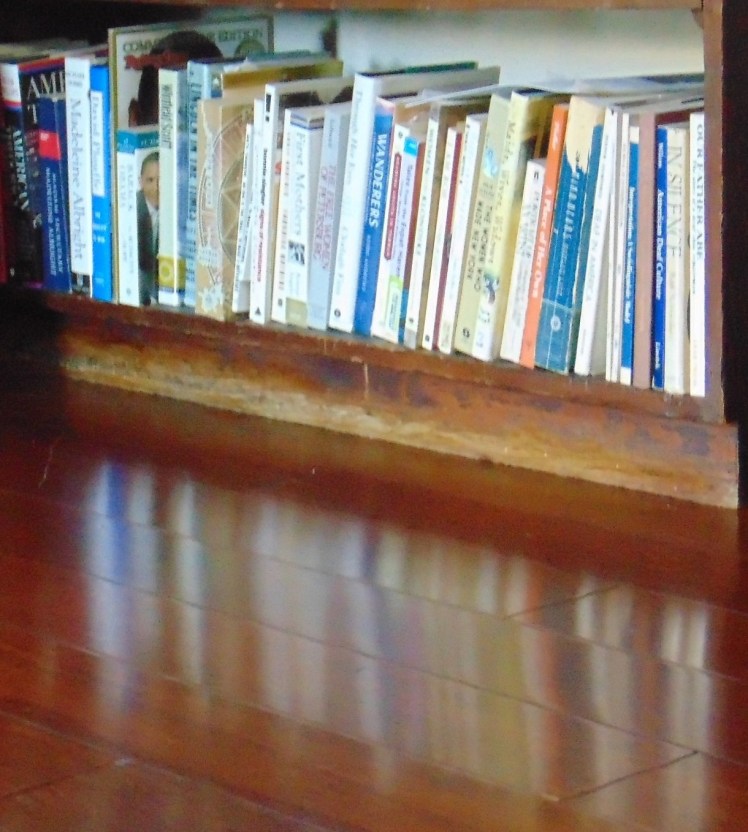
Trade Talk: New Indie Book Bestseller Lists

Bookshelf

Publisher’s Weekly has announced that “The Independent Publishers Caucus, a collective of 117 small and independent publishers, has announced the launch of a new weekly bestseller list in partnership with the American Booksellers Association, creating what organizers say is the first national ranking focused exclusively on independent press titles sold at independent bookstores…Dubbed the Independent Press Top 40” (find the rest of PW’s article here).

Regularly publicizing a ranking of independent press titles (“indie books”) sold at independent bookstores is a great idea. This promotes small businesses. It provides attention for authors whose voices might not otherwise be getting large-scale public notice – making it more possible for readers to discover new-to-them authors.

A couple of examples demonstrate the value of this “Independent Press Top 40” list.

  • I personally buy several books per year from several niche publishers in a specific industry whose books (topics) I value. I happen to be “in the know” about the particular market for which these book publishers provide titles, so I know to follow these publishers. With that said, I know people who would likely want to read the same types of books I’m reading, but who aren’t likely familiar with the publishers whose websites I visit regularly. Any mechanism that supports “get out the word” for such indie publishers is a win-win-win-win for publishers, authors, readers, and the sustainability of “shop local” business practices.
  • My hometown (Bellingham, Washington) – like many communities – has a beloved local bookstore. Village Books and Paper Dreams is a valued hub in the community. This new weekly national “Independent Press Top 40” ranking is another way to keep such small bookstores in the public eye – thereby supporting great businesses.

While we’re talking indie booksellers, I’m happy to plug my two favorite online booksellers:

  • Hamilton Books. Based in Connecticut, Hamilton Books is based in Connecticut, USA and has been around since 1969. They specialize in selling discounted books to U.S. customers. I love Hamilton Books. They sell books via their website and a print magazine. I discovered them more than twenty years ago when they somehow got my name and mailing address; they sent me one of their magazines listing a sampling of their book inventory. It was actually their magazine that I fell in love with – their listing of quirky and off-the-wall titles of available books. I started buying from them for the purpose of staying on their mailing list (this is a sentence that every marketer wants to read!). Reading their lists of “off-the-wall titles” – such as “off the beaten track” historical books and books on political and religious conspiracy theories from “every end the political and religious spectrums” – literally became Friday night entertainment for me.
  • Thrift Books (their marketing angles: “gift more, spend less” and “read more, spend less”). This Washington State-based bookseller calls themself “the largest online independent used book seller. A friend told me about them last spring; I have already purchased enough books to achieve their highest reader/purchaser tier of “Literati Elite.” Their “Reading Rewards” program is simple yet fun – the more you buy, the more book-buying benefits you get….. Their membership tier program seems to be tied into our digital age approach to tapping dopamine receptors – our brains get a “dopamine high” every time we “like” or “achieve” something via a click-of-the-mouse….. Of course, book lovers like joining “Literati Elite” status……

I encourage you to click on this weekly Independent Press Top 40 and add to however you track websites that you visit regularly (add it to your browser faves, whatever). You just might find your next great read!

Kim Burkhardt provides writing services – including ghostwriting, “corporate storytelling,” articles, how-to manuals, and editing – at Burkhardt Writing Services. Contact us about your wordsmithing and storytelling needs.

Author reflection: writing ancestor’s biographies

Harriet Susannah Ellis was born on February 5, 1863 in Riverstown, County Sligo, Ireland.

Her oldest surviving son – my Irish-born great-grandfather – lived until I was thirteen. I have fond memories of him – including the time when he fell asleep at my birthday party (I was turning eight) and the party stopped so that the children in attendance could watch him snore with an Irish brogue. When I was three or four, he carried me around his yard in a wheelbarrow – great fun for a young child. I still buy deep purple pansies because he had deep purple pansies in his yard when I was a child.

When I was growing up, we heard stories about my great-grandfather’s childhood in rural Ireland (County Wicklow). We heard about his blind father (I, in turn, was raised by my blind mother). We heard about his paternal uncles and paternal grandfather who were doctors (in 2018, I visited Trinity College Dublin where they did their medical degrees in the 1800’s. It gave me chills to realize they had walked the same hallways when I walked through the campus’s historical library).

Yet, I realized in 2013 that I knew nothing about my great-grandfather’s mother. Surely she had existed, confirmed by the fact that she had children whose lives I knew about. I had never heard any mention of her. I didn’t even know her name.

Because we live today in a digital age, I was able to go online in search of information about my great-grandfather’s mother. Within a fairly short time, online genealogical research led me to her name. Harriet Ellis. Specifically, Harriet Susannah Ellis. Beyond that, I didn’t find much. In January, 2014, I decided to do a Google search of her name. Fortunately, I found a post on a genealogy website written by her youngest brother’s grandson. Great! I contacted him.

When I contacted Harriet’s youngest brother’s grandson, it turned out that he lives in a Dublin suburb. Much to my happy surprise, he had been driving around Ireland for twenty years looking up genealogical records of our ancestors (I am fortunate – not every budding genealogist finds such a relative!). He was happy to share the information he had been meticulously collecting.

Fast forward. I began organizing data about my Irish ancestors into book form. I contacted other descendants – collected their info about recent generations. I collected old family photographs, old family letters that had been saved, family stories that had been passed down. All of this became our family’s genealogy book (see my previous post about my Irish genealogy book).

By the time we printed our genealogy book and had the first family reunion since 1980, I had learned much about Harriet’s life. She was born in the same Irish county as William Butler Yeats’ family at about the same time (did she ever cross paths with him?); the county where she was born was also where Bram Stoker’s mother was born (Bram Stoker seems to have gotten several ideas for his Dracula novel from stories his mother told about County Sligo’s cholera epidemic in the 1930’s). Harriet had thirteen children, ten of whom lived. She filled out the birth certificate and the death certificate for her first-born child who died two hours after an unattended home birth. Her father was a school master who moved from job to job, taking his wife and children all over Ireland via Ireland’s newly-emerging train system. She eloped. As the daughter and sibling of school masters, she valued education for her children. She emigrated in the 1900’s. She died the same day that the Soviets invaded Poland. I suggested to my Dublin-area distant cousin that we continue on, writing Harriet’s biography. We did.

Writing Harriet’s biography was made possible as a result of many years of genealogical research. A point I want to stress is that books are often the end-result of much learning and effort. The book was also a labor of love. Writing a book is an effort that requires learning the mechanics of writing (we learn at least some if this in school), learning what’s involved in making information presentable and interesting, and putting in the time to write. Having an editor go through one’s written material helps identify needed improvements before publishing a book (identifying spelling and grammar that need correction, spotting incomplete presentations of information that are overlooked when knee-deep in the writing process, noting shifts in perspective or narrative style that need correction, etc.).

I am also pleased to have contributed to bringing stories of every day historical women’s lives to print. After we published Harriet’s biography, I came up a research network that studies “Perceptions of pregnancy.” I wrote an article for their website about Harriet’s experience of childbearing: An Experience of Home Births in Rural Ireland: 1883 – 1903.

I hope you will take an interest in Harriet’s biography.

Kim Burkhardt provides writing services at Burkhardt Writing Services. Contact us about your wordsmithing needs.